Ragesh B. Thandassery, MD1, Casey Barnett, PharmD2, Allison A. Wells, MS3, Cem Cengiz, MD2 1Central Arkansas Veterans Healthcare System, Little Rock, AR; 2Central Arkansas Veterans HealthCare System, Little Rock, AR; 3University of Arkansas for Medical Sciences, Little Rock, AR
Introduction: Elderly patients are increasingly registered for orthotopic liver transplantation (OLT) in recent years, however large studies describing their clinical features are unavailable. We aim to characterize the clinical features of patients above 70 years of age who were wait listed for OLT in the United Network for Organ Sharing registry.
Methods: All adult patients (≥18 years) registered for OLT in the UNOS program from Jan 2003 to March 2024 were studied. We attempted to identify the wait list characteristics, transplant outcomes, and long-term graft survival. Patients lost to follow up were excluded.
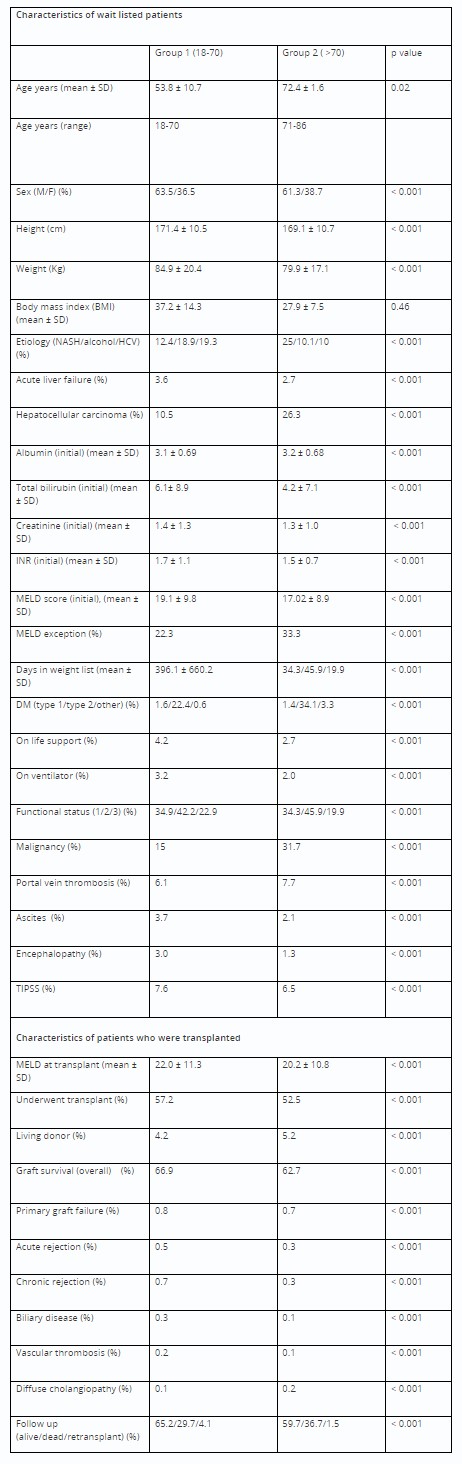
Results: 236,302 patients were waitlisted; 230,363 (97.5%) were ≤70 years (group 1) and 5939 (2.5%) were >70 years (group 2). Proportionately more females were listed in group 2, the ethnic composition and BMI were similar in both groups. The etiology was predominantly non-alcohol fatty liver disease in group 2 and chronic hepatitis C in group 1. Proportion of patients with hepatocellular carcinoma was higher in group 2. The lab values (at registration and at transplantation) showed higher albumin, lower serum creatine, lower total bilirubin, lower INR, and lower MELD scores in group 2. Group 2 patients were less often on life support and ventilator at the time of registration. Patients in group 2 were less sick and had better functional status at registration and at the time of OLT. More patients received MELD exception in group 2. A higher proportion of waitlisted patients in group 1 underwent OLT.
Higher proportion received living related donor organ in group 2. The occurrence of acute and chronic graft rejection was lower in group 2. Similarly primary graft failure, biliary disease, vascular thrombosis and re-transplants were lower in group 2. Diffuse cholangiopathy were higher in group 2.
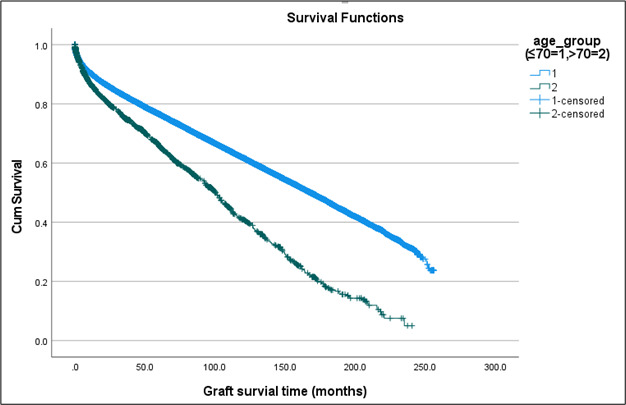
The overall graft survival (68.7% vs 61.9%) and 1-, 3- and 5-year graft survival were higher for group 1 (90.1%, 82.6%, 76.5% vs 86.1%, 75%, 65.8%, p< 0.001)
Discussion: A small but significant proportion of elderly patients ( >70 years) were registered for OLT, their clinical and lab features show less severe disease at registration and transplantation. Lower proportion of elderly patients (from wait list) eventually underwent OLT, their post-OLT course indicated lesser graft rejection, vascular complications and re-transplants, and higher occurrence of diffuse cholangiopathy. The overall graft survival in elderly patients although slightly lower is highly impressive.
Figure: Comparison of graft survival between the groups (age ≤ 70 and age >70). Legend: P value= <0.001 (n; Group = 124970 and Group 2 =3006)
Table: Clinical and laboratory characteristics of patient groups Legend: Functional status- 1= no, 2 = some, and 3 = total assistance; TIPSS- transjugular intrahepatic portosystemic shunt
Disclosures:
Ragesh Thandassery indicated no relevant financial relationships.
Casey Barnett indicated no relevant financial relationships.
Allison Wells indicated no relevant financial relationships.
Cem Cengiz indicated no relevant financial relationships.
Ragesh B. Thandassery, MD1, Casey Barnett, PharmD2, Allison A. Wells, MS3, Cem Cengiz, MD2, 25, Clinical Characteristics of Patients Older Than 70 Years Registered for Liver Transplantation: Analysis of 22 Years Data From UNOS Registry, ACG 2024 Annual Scientific Meeting Abstracts. Philadelphia, PA: American College of Gastroenterology.